
What makes a great APC/optimisation Application?
Advanced Process Control (APC) and optimisation applications are common in most process industries. The APC and optimisation software has evolved significantly over the last 40 years. The evolution of implementation methods has evolved at a slower pace and perhaps has not embraced the full feedback from users of the technology. What should engineers learn from client feedback and what are the important aspects of a well-designed APC/optimisation application?
Do we know what industry is telling us?
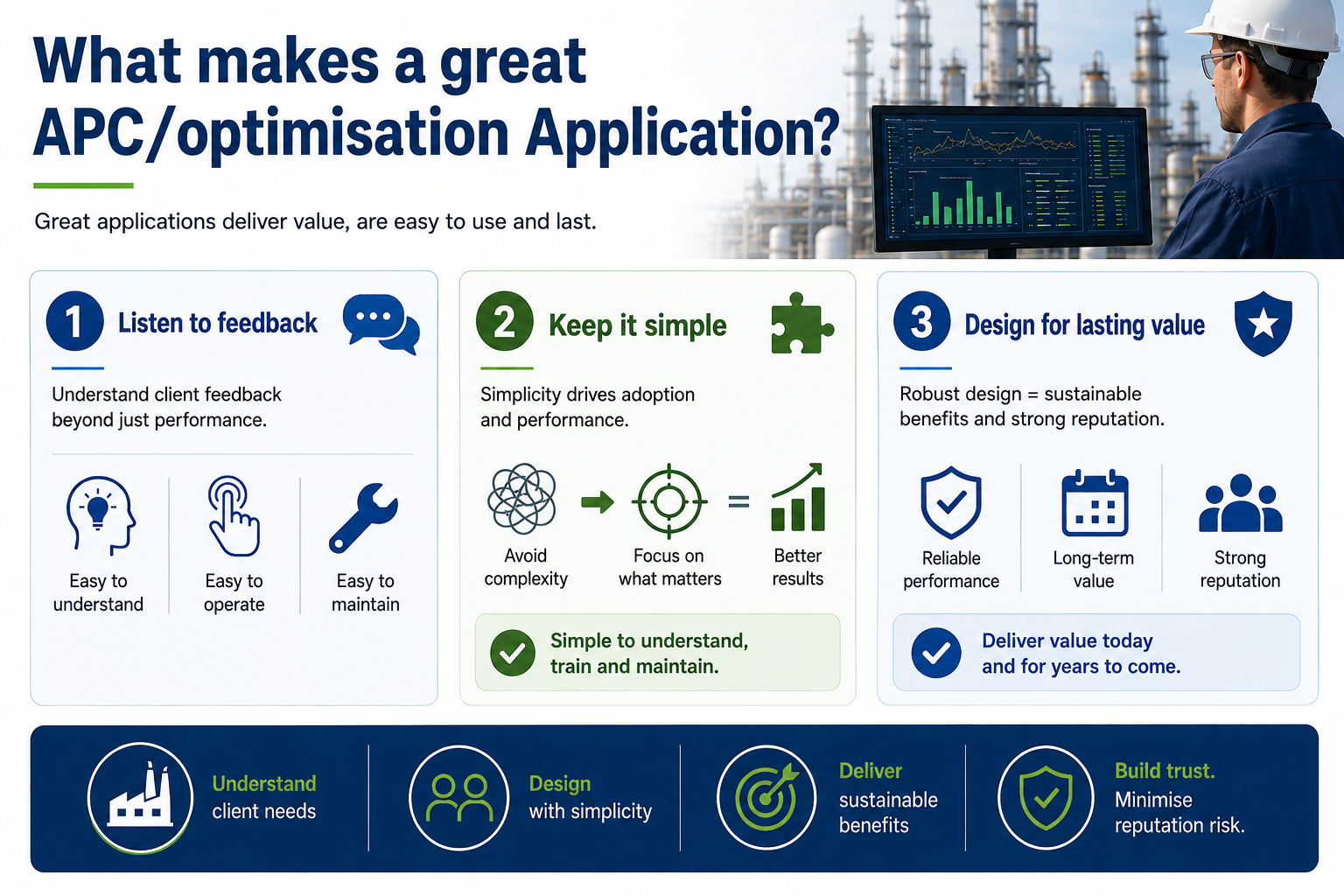
Process control engineers understand feedback as it applies to signals from the process feeding back to a device such as a PID loop or an APC/optimisation application. We are good at that. My observation is that Process control engineers are not so good at extracting feedback on implemented solutions from our clients. Yes, I said extracting because feedback is sometime not forthcoming from the industries we serve, mainly because many companies are new at adopting APC and optimisation technologies and do not have the experience of understanding all aspects of it. In the case of clients who have many years of experience with APC and optimisation, there is a lack of structure around providing feedback. The sort of feedback that is lacking is “soft” aspects of the implemented solution. What is “soft” feedback? Some examples of “soft” feedback are ease of understanding the APC/optimisation solution, ease of operating and ease of maintaining the solution. As Process control engineers, we must understand these aspects of our implemented solutions so we can take this feedback into account for our next implementations.
Understand client perspective and simplify design
During my early days as an APC engineer, it was very common to build large, complicated APC applications. These applications worked well when the external consultant was present but degraded in performance in the months following the commissioning phase. Why did this happen and why does it still happen? I attribute large part of this degradation on three issues, complicated design, poor training and difficult to maintain application. In fact all these issues stem from one root cause – complicated design. These same issues are prevalent in optimisation applications as well.
An important role of the APC and optimisation engineer is to marry the technical capability of the technology they are using with their knowledge and client requirements. These three elements need to come together in formulating an application that produces benefits whilst maintaining simplicity at the heart of the application. Engineers should think twice before adding complex calculations that would be problematic for clients to understand and maintain. Another potential source of complications is the urge to “automate everything” by including lots of logic. Simplicity will result in ease of understanding, training and maintenance.
Minimise reputation risk, maximise longevity of applications
There is an argument to be made that adding some level of complication will squeeze out the extra 5 to 10% of benefit. Whilst this may be true, if the application is turned OFF more often due to the issues mentioned above, then these extra benefits cannot be realised in any case.
A robust design will stand the test of time by delivering good benefits for many years to come. Longevity of the application will come with a good reputation for the implementation team and minimise reputation risk.